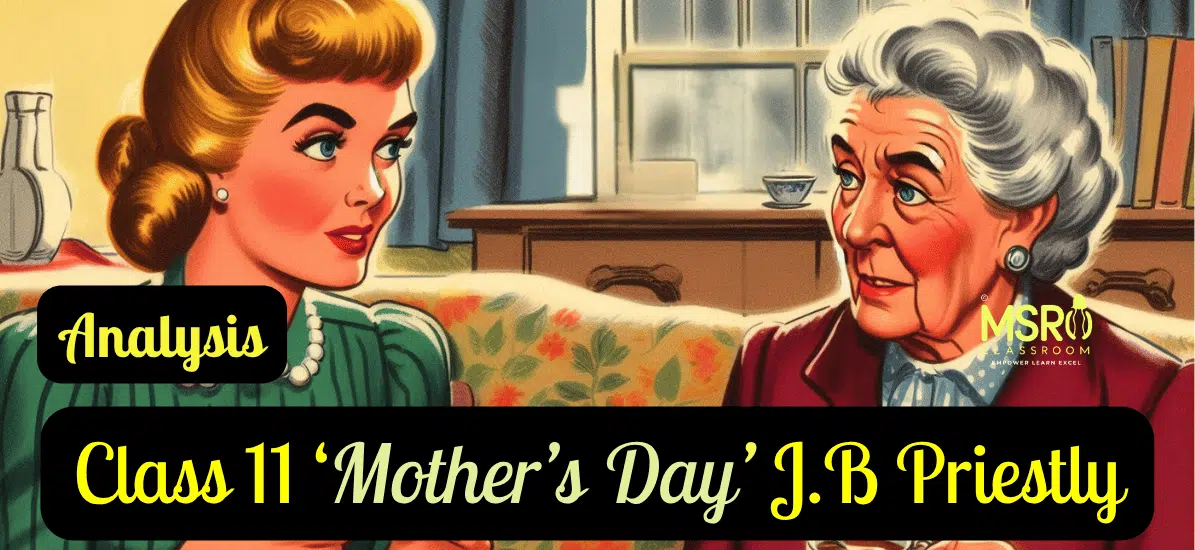
Chapter 3- J.B. Priestley’s ‘Mother’s Day’ Summary, Idiomatic Expressions, Theme, Important Passages, Character Sketch, Textbook Questions and Extra Questions.
Chapter 3- Mother’s Day by J. B. Priestley:
Table of Contents
More from Class 11: Poem- ‘Childhood‘ by Markus Natten,
Vocabulary:
Idiomatic Expressions used in the play ‘Mother’s Day’ by J.B. Priestley:
Put your foot down: Assert authority firmly. Good gracious: Exclamation of surprise. Keep dropping a hint: Suggest something indirectly. Have it out with them: Directly discuss a problem. Get a square meal: Have a substantial meal. It’s a bit much: Excessive or unfair. Given myself up as a bad job: Admit failure. Feeling off-colour: Feeling unwell. Snap out of it: Improve mood suddenly. Get cracking: Start immediately. You clot!: Insult for foolishness. Sounds far-fetched: Improbable. Two front dress circles for the first house: Prime theatre seats for the first performance. It’s a bit thick: Unfair or unreasonable. Made a fuss off: Create a commotion. To be waited on hand and foot: To be treated with great attention. I’m all for a steady going on: Preference for stability. Silly old bag: Derogatory for an older foolish woman. Young piecan: Insult for an immature person. Putting them in their places: Asserting authority. Doing them all a world of good: Benefiting greatly. Eating out of your hand soon: Easily influenced by someone. Crying her eyes out: Intense sobbing. We’re at sixes and sevens: State of confusion. I’m off my chump: Feeling bewildered. You must be tiddly: Slightly drunk. Ticking her off: Scolding someone. You’re done for: Facing serious trouble. Give me a hand (with supper): Requesting help. |
Summary ‘Mother’s Day’:
In “Mother’s Day,” by J.B. Priestley, Mrs Pearson, a hardworking and unappreciated mother, uses magic to swap personalities with her bold neighbour, Mrs. Fitzgerald. The transformation shocks her family—husband George, daughter Doris, and son Cyril—who are used to her docile nature. Mrs Pearson, now assertive and confident, demands respect and points out their neglectful behaviour.
The family initially reacts with surprise and discomfort but gradually realises their mistakes. By the end of the play, they promise to be more considerate and helpful. Mrs Pearson and Mrs Fitzgerald then return to their original selves. The play humorously highlights a mother’s need for respect and appreciation.
Explanation of ‘Mother’s Day’ for Auditory Learners:
Theme ‘Mother’s Day’:
The theme of “Mother’s Day” centres on the challenges and dynamics within a family, focusing mainly on mothers’ roles in the 1950s. The play satirically explores how societal expectations and traditional gender roles influence family relationships. It critiques the undervaluation of mothers and their often-overlooked contributions to the household.
Through humour and satire, J.B. Priestley portrays Mrs. Pearson’s transformation from a submissive figure to a more assertive one, highlighting the tensions and conflicts this change brings within the family. The play also explores generational differences and the impact of external influences, such as neighbours, on family dynamics. “Mother’s Day” offers a humorous yet critical commentary on family life and the evolving roles of women in society during the mid-20th century.om a submissive figure to a more assertive one, highlighting the tensions and conflicts this change brings within the family.
More in the video.
Character Sketch:
1. Character Sketch of Mrs Annie Pearson:
Mrs. Pearson experiences a significant transformation from a submissive and apologetic figure to one of polite assertiveness, influenced by her personality swap with Mrs. Fitzgerald. Initially characterized by her self-sacrificing nature and reluctance to address familial issues, she evolves into a confident leader who challenges the status quo and demands respect.
1. Age: In her forties.
2. Physical Appearance:
- Pleasant-looking but worried and anxious.
3. Voice and Tone:
- Speaks in a light, flurried tone.
- Has a touch of suburban Cockney in her accent.
4. Personality:
- She is kind and gentle but often taken for granted by her family.
- Unassertive and accommodating, she rarely stands up for herself initially.
- Worried and anxious, especially about pleasing her family.
5. Role in the Play:
- Central character whose transformation drives the plot.
- She is initially portrayed as a downtrodden housewife who does everything for her family without receiving much appreciation.
- Through the influence of Mrs. Fitzgerald, she becomes more assertive and demands respect from her family.
6. Interactions with Other Characters:
- Initially submissive in her interactions with her husband George, daughter Doris, and son Cyril.
- After the identity swap with Mrs Fitzgerald, she becomes more assertive and challenges her family’s behaviour.
- She gains respect and changes the dynamics within her family by the end of the play.
7. Impact on the Plot:
- Her transformation is crucial to the play’s exploration of self-respect and empowerment and the importance of balanced family relationships.
- Demonstrates the importance of mutual respect within a family and the need for personal boundaries.
8. Behaviour and Actions:
- Initially does all the household chores without complaint.
- After the swap, she refuses to be a doormat and stands up for herself.
- She begins to assert her own needs and desires, leading to a shift in the family dynamics.
2. Character Sketch of Mrs Agatha Fitzgerald:
1. Age: Older than Mrs Pearson, likely in her late forties or fifties.
2. Physical Appearance:
- Heavier build, suggesting a more imposing physical presence.
- Often depicted smoking, which adds to her strong and somewhat sinister aura.
3. Voice and Tone:
- Has a deep voice, possibly with an Irish accent, contrasting sharply with Mrs. Pearson’s lighter, more flurried tone.
4. Life:
- Wife of a Lieutenanant Quatermaster.
- She learned twelve years of fortune-telling in the East.
5. Personality:
- Strong and assertive, able to take control of situations and influence others.
- Sinister and intimidating, able to evoke a sense of unease or respect from those around her.
- Confident and unafraid to speak her mind, often providing candid and direct advice.
6. Role in the Play:
- Act as a catalyst for change in Mrs Pearson’s behaviour, encouraging her to stand up for herself and assert her needs and desires.
- She uses her influence to challenge the dynamics within the Pearson family, transforming their interactions.
7. Interactions with Other Characters:
- Takes a dominant role in her interactions with Mrs. Pearson, guiding and instructing her.
- Viewed with a mix of respect and apprehension by the Pearson family due to her strong personality.
8. Impact on the Plot:
- Her decision to swap identities with Mrs. Pearson is central to the play’s exploration of themes like self-respect and family dynamics.
- Her actions and advice lead to significant changes in the behaviour of the Pearson family members, driving the play’s resolution.
3. Character Sketch of George Pearson:
In the play “Mother’s Day,” George Pearson embodies the challenges experienced by a father and husband as he confronts his insecurities, family expectations, and his wife’s newfound assertiveness. His journey reveals both his weaknesses and moments of self-reflection, depicting a man striving to maintain authority amid personal and social challenges.
1. Age: About fifty years old.
2. Appearance:
- Fundamentally decent in appearance.
- Solemn expression.
- Hefty build, suggesting a heavy and slow-moving demeanour.
3. Personality:
- Self-important and takes himself very seriously.
- Pompous and somewhat arrogant in his demeanour.
- Decent at heart but often insensitive and oblivious to others’ feelings.
4. Role in the Play:
- Represents the traditional patriarchal figure within the family.
- Initially portrayed as dominating and dismissive of others’ opinions.
- His interactions with his wife and children reflect a lack of understanding and empathy.
5. Interactions with Other Characters:
- Dominates conversations and decisions within the family.
- He often dismisses his wife’s concerns and opinions.
- His reaction to Mrs. Fitzgerald calling him by his first name highlights his desire for formality and respect (the same applies to Cyril Pearosn).
6. Behaviour and Actions:
- He spends a significant amount of time at the club, which causes friction at home.
- He is insensitive to his wife’s emotional state and dismisses her worries.
- He reacts defensively when confronted with uncomfortable truths about his behaviour.
- George’s discomfort with Mrs. Fitzgerald’s presence shows his unease with outsiders witnessing his family’s internal issues.
7. Impact on the Plot:
- His character illustrates the challenges of traditional gender roles and expectations.
- His character develops through conflict with Mrs. Pearson. He confronts his flaws and the consequences of his actions.
- George is portrayed as a traditionalist, rigid in his views and actions, yet vulnerable to criticism and internal family dynamics.
- Reflects on the consequences of neglecting family responsibilities and emotional support.
4. Character Sketch of Cyril Pearson:
Cyril Pearson is a typical, carefree young adult who tends to be self-centered. His character illustrates the generational gap and emphasizes the importance of empathy and responsibility within the family. His journey reflects themes of personal growth and highlights the need to recognize and appreciate the efforts of family members.
1. Personality Traits:
- Casual and Laid-back: Cyril is relaxed and not overly concerned about responsibilities or serious matters.
- Self-centred: Tends to think more about his needs and interests than his family members.
- Conformist: He often goes along with the status quo and does not challenge or question much about his family dynamics.
2. Behavior Towards Family:
- Dependent: Relies on his mother for various needs, such as meals and general care.
- Unaware: He does not fully recognise and appreciate the amount of work his mother does for the family.
- Respectful but Distant: He maintains a respectful tone but is emotionally distant from his parents.
- Friendly: Generally amiable in his interactions with others.
- Superficial: His interactions lack depth and genuine concern, indicating a focus on surface-level engagements.
3. Role in the Pearson Family Dynamic:
- Passive: Takes a backseat in family matters, allowing others to make decisions and take charge.
- Recipient of Care: He is more of a recipient of his mother’s care than a contributor to household responsibilities.
4. Development Throughout the Play:
- Initial Ignorance: The play begins with his unawareness of his mother’s feelings and her burdens.
- Growing Awareness: Gradually becomes more aware of his mother’s dissatisfaction and the need for change in family dynamics.
- Potential for Change: The end of the play hints at Cyril’s possible transformation into a more considerate and responsible person.
5. Character Sketch of Doris Pearson:
Doris is a young woman who is emotionally sensitive and reactive, struggling with a complex relationship with her family, especially her mother. Her actions and reactions reveal her ongoing emotional turmoil and the dynamics within her household.
1. Physical Appearance:
- Doris Pearson is described as a pretty young woman.
- Despite her physical appeal, her spoiled nature can detract from her pleasant appearance.
2. Personality:
- Defiant and Discourteous: Doris often displays defiance towards her mother, Mrs. Pearson, and can be disrespectful in her interactions.
- Impulsive: Her decision to cancel plans with Charlie Spence based on her mother’s comments demonstrates a degree of impulsiveness.
- Emotional Vulnerability: Doris shows vulnerability and sensitivity despite her assertiveness and defiance. She tends to cry easily and becomes upset quickly.
- Spoiled Nature: Displays entitlement and a tendency to expect things to go her way, contributing to conflicts within the family dynamic.
3. Emotional State:
- She demonstrates vulnerability and sensitivity, as evidenced by her tendency to cry and become upset quickly.
- Shows a range of emotions, from sobbing to frustration, indicating a depth of feeling and sensitivity.
4. Relationship with Family:
- Doris appears to have a strained relationship with her mother, Mrs Pearson, possibly due to clashes in personality and differing opinions.
- Her spoiled nature may contribute to conflicts within the family dynamic.
5. Interactions with Others:
- Her emotional state influences her interactions with other characters, such as her father, George, and family friend, Mrs. Fitzgerald.
- Reacts strongly to perceived criticism or negative remarks, suggesting a sensitivity to external opinions.
Question Answers “Mother’s Day” by J.B. Priestley:
Textbook Questions Answers:
Q1: This play, written in the 1950s, is a humorous and satirical depiction of the status of the mother in the family.
(i) What are the issues it raises?
- The play highlights the family’s lack of appreciation for mothers, the unequal distribution of household responsibilities, and the emotional neglect they face. It critiques the patriarchal attitude in which mothers are taken for granted, and their efforts are unacknowledged.
(ii) Do you think it caricatures these issues, or do you think that the problems it raises are genuine? How does the play resolve the issues? Do you agree with the resolution?
- While the play uses humour and exaggeration, the issues raised are genuine. The characters’ exaggerated behaviours emphasise real societal problems, such as the undervaluation of a mother’s role and the complacency of other family members.
- The play resolves the issues through a role reversal, where Mrs. Pearson gains respect and acknowledgement by asserting herself. This shift prompts the family to realise their neglect and change their attitudes.
- The resolution, though simplistic, effectively highlights the need for mutual respect and shared responsibilities in families. I agree with the resolution as it conveys an important message about valuing and respecting every family member’s contributions.
Q2: If you were to write about these issues today, what are some of the incidents, examples and problems that you would think of as relevant?
A2: If I were writing about these issues today, I would highlight situations such as a mother balancing work and home responsibilities without any assistance. For instance, many Indian mothers manage their careers while also taking care of all household chores.
I would address issues like family members not appreciating a mother’s efforts and often taking her for granted. Children and spouses may also expect mothers to serve them without recognising their own needs or desires.
Current relevant issues also include the emotional burden on mothers who rarely find time for themselves. I emphasise the importance of sharing responsibilities at home and acknowledging the hard work mothers put in to create a happier, more balanced family life.
Q3: Is drama a suitable medium for conveying a social message? Discuss.
A3: Drama is an effective medium for conveying social messages. It presents important issues in an engaging and relatable way. The characters and their stories often reflect real-life situations, allowing the audience to easily connect with the message. Drama has the power to evoke emotions and provoke thought, encouraging deeper reflection on social issues.
Humour and satire can be incorporated into drama to highlight societal problems and make serious topics more approachable. Watching a play lets the audience see different perspectives and understand the impact of different behaviours and attitudes. This can foster greater awareness and inspire change within society.
Ultimately, drama effectively combines entertainment with education, making it a powerful tool for social commentary.
Q5: Discuss in groups plays or films with a strong message of social reform that you have watched.
A5: In our group discussion, we focused on plays and films that address social reform regarding women’s status in society. One notable film we examined is “Thappad,” which deals with domestic violence and emphasizes the importance of self-respect. It chronicles a woman’s journey as she stands up against abuse, even when it comes from a loved one.
Another film we discussed is “Dangal,” which highlights the struggles and achievements of female wrestlers in a male-dominated sport.
In addition to women’s status, we also talked about the popular film “3 Idiots,” which carries a strong message about social reform. This movie critiques the pressures of the Indian education system and underscores the importance of pursuing one’s true passion.
These works are influential because they reflect real issues and inspire viewers to consider gender equality and women’s rights. They demonstrate that change is possible and encourage society to support women’s empowerment.
Extra Questions “Mother’s Day” by J.B. Priestley:
Short Answer Type Questions:
Q1: How does George react to Doris’s emotional state, and what does this reveal about his character?
A1: George is confused and concerned about Doris’s crying but doesn’t know how to handle it. His reaction shows he values stability and dislikes change. George’s bewilderment and lack of sensitivity reveal that he is somewhat detached and does not understand his family’s emotions.
Q2: What is George’s attitude toward Mrs Pearson drinking stout, and what does this signify about her changing behaviour?
A2: George reacts with surprise and disapproval when he sees Mrs Pearson drinking stout during the day, suggesting a change in her behaviour. Mrs Pearson is asserting her independence and breaking from traditional norms, which George finds unsettling and unexpected within their household dynamics.
Q3: How does Mrs Pearson’s revelation about the club’s nickname for George impact him?
A3: Mrs Pearson reveals that the club calls George “Pompy-ompy Pearson,” making him realise they laugh at him. This deeply shocks and hurts George, making him feel embarrassed and humiliated. It shatters his belief that the club respects him, significantly affecting his self-esteem.
Q4: What is Cyril’s reaction to Mrs Pearson’s changed attitude, and what does this indicate about their relationship?
A4: Cyril is surprised and upset by Mrs Pearson’s changed demeanour. He argues with her, feeling hurt and confused. It suggests he isn’t used to her being assertive and strict, highlighting their previous relationship, where he likely took her for granted.
Q5: How does Mrs Pearson’s interaction with Mrs Fitzgerald differ from her interactions with her family?
A5: Mrs Pearson (now with Mrs Fitzgerald’s personality ) is confident and assertive with the family. In contrast, the real Mrs Fitzgerald, with Mrs Pearson’s personality, is nervous and cautious. The swap shows Mrs Fitzgerald’s strong influence, making the family respect Mrs Pearson more.
Q5: What does Mrs Pearson imply about George’s behaviour at the club compared to at home?
A5: Mrs Pearson implies that George is mocked at the club, where they call him “Pompy-ompy Pearson” behind his back. At home, he acts self-important and expects respect. The contrast implies he is less respected or admired outside the house than he believes.
Q6: How does George’s attitude shift after learning the truth about his reputation at the club?
A6: George is shocked and hurt when he learns the truth about his reputation at the club. He grows quiet and introspective, realising he isn’t as respected as he thought. The revelation humbles him, making him more open to listening and changing his behaviour at home.
Q7: How does the exchange between Mrs. Pearson and Cyril illustrate the family’s general attitude toward her?
A7: The exchange between Mrs Pearson and Cyril shows that the family doesn’t respect her. Cyril is dismissive and sulky, revealing that they take her for granted. Mrs Pearson’s assertiveness surprises Cyril, suggesting that they aren’t used to her standing up for herself.
Q8: Why does Mrs. Pearson insist that George address Mrs. Fitzgerald politely, and what does this reveal about her expectations?
A8: Mrs Pearson (now with Mrs Fitzgerald’s personality) insists that George address Mrs Fitzgerald politely to teach him good manners and respect. It reveals her expectation for better behaviour and decency within the family. She wants everyone to treat others courteously, highlighting her desire for a more respectful household environment.
Q9: What final advice does Mrs Fitzgerald give Mrs Pearson at the end of the play, and why is it significant?
A9: Mrs Fitzgerald advises Mrs Pearson to keep a firm hand and not go soft on her family. It is significant because it emphasises the need for Mrs Pearson to maintain her newfound assertiveness to ensure lasting respect and better behaviour from her family.
Q10: How does Mrs Pearson’s refusal to prepare tea for George highlight the shift in her attitude?
A10: Mrs Pearson’s refusal to prepare tea for the family highlights her shift from being a submissive, taken-for-granted homemaker to someone who asserts her needs and desires. The change shows she no longer accepts being undervalued and demands respect from her family.
Q11: What does Mrs. Pearson’s criticism of Cyril’s activities reveal about her perspective on their family life?
A11: Mrs Pearson’s criticism of Cyril’s activities reveals her frustration with the lack of responsibility and respect in their family life. She feels everyone takes her for granted and contributes too little, highlighting her desire for a more balanced, respectful household dynamic.
Q12: How does the family react to Mrs Pearson’s newfound assertiveness, and what does this indicate about their previous dynamic?
A12: The family reacts with surprise and discomfort to Mrs Pearson’s newfound assertiveness. It suggests they had previously taken her for granted and didn’t respect her. Her assertiveness forces them to reconsider their behaviour and how they treat her.
Q13: What is the significance of Mrs Pearson’s comparison between George’s behaviour at the club and home?
A13: Mrs Pearson’s comparison between George’s behaviour at the club and at home highlights her dissatisfaction with his double standard. It shows her frustration that George presents himself differently in social settings than he does at home, revealing a lack of authenticity and respect in their relationship.
Q14: How does the conversation between Mrs. Pearson and Mrs. Fitzgerald after the family leaves highlight the play’s central theme?
A14: After the family leaves, Mrs Pearson and Mrs Fitzgerald discuss the need for firmness and consistency in managing family dynamics. It highlights the play’s central theme of the challenges within family relationships, the underappreciation of mothers and the importance of asserting authority to maintain harmony and respect among family members.
Q15: How does Doris’s response to Mrs. Pearson’s critique of Charlie Spence reflect her relationship with her mother?
A15: Doris’s defensive response to Mrs Pearson’s critique of Charlie Spence reflects a strained relationship with her mother. It suggests Doris feels criticised and misunderstood, possibly indicating a pattern of tension and miscommunication, where she reacts defensively to her mother’s judgments or advice.
Q16: What does Mrs. Pearson’s final plan for the evening suggest about her intentions for the family’s future interactions?
A16: Mrs Pearson’s final plan for a family game of rummy and joint supper preparation suggests her intention to foster unity and cooperation within the family. By proposing these activities, she aims to improve their interactions and behaviour towards her, create a more harmonious atmosphere at home, and move away from previous conflicts and misunderstandings.
Q17: How does Mrs Fitzgerald’s role in transforming Mrs Pearson’s behaviour contribute to the play’s resolution?
A17: Mrs Fitzgerald plays a pivotal role by guiding Mrs Pearson to assert herself and change her family’s dynamics. Her influence encourages Mrs Pearson to adopt a firmer approach, fostering understanding and harmony within the family. The transformation helps resolve conflicts and improve relationships, leading to a more favourable outcome in the play.
Q19: How does the family’s apprehension at the end of the scene set the stage for future changes in their behaviour?
A19: At the end of the scene, the family’s apprehension suggests they are uncertain yet hopeful about Mrs Pearson’s new approach. Their reactions hint at anticipating changes in their behaviour, reflecting readiness to adapt to her assertiveness. This sets the stage for potential improvements in their interactions and family dynamics.
Long Answer Type Questions:
Q1: Why did Mrs. Fitzgerald need to swap identities with Mrs. Pearson in “Mother’s Day,” and what circumstances or motivations led to this decision?
A1: Mrs Fitzgerald felt the need to swap identities with Mrs Pearson in “Mother’s Day” because she saw the Pearson family’s dynamics as strained. Mrs Pearson was often taken for granted and not respected by her husband and children. The identity swap was motivated by Mrs Fitzgerald’s desire to teach the Pearson family a lesson about appreciating their mother and wife. She believed that assertiveness and tough love were necessary to shake them out of their complacency and improve their relationships.
By adopting Mrs Pearson’s persona, Mrs Fitzgerald aimed to instil discipline, assertiveness, and responsibility in the family, hoping they would learn to value Mrs Pearson’s contributions. Mrs Fitzgerald’s decision highlights her role as a catalyst for change and the themes of maternal authority and respect within the family unit.
Q2: What is the significance of Mrs. Pearson drinking stout, and how does George react?
A2: In J.B. Priestley’s play “Mother’s Day”, Mrs Pearson’s decision to drink stout is significant because it marks a change from her usual behaviour and surprises her husband, George. Traditionally, Mrs Pearson is portrayed as steady and predictable. However, her choice to drink stout during the day disrupts George’s expectations and challenges his sense of what is appropriate.
George reacts with bewilderment and disapproval, expressing surprise that she would choose to drink alcohol at that time. Their interaction highlights their differing attitudes toward routine and etiquette: George prefers steadiness and order, while Mrs Pearson, influenced by Mrs Fitzgerald’s personality, begins to assert her own desires and preferences. This scene sets the stage for Mrs Pearson’s growing assertiveness and George’s discomfort with changes in their household dynamics.
Q3: How does Mrs Pearson reveal George’s status at the club to him, and what is his reaction?
A3: Mrs Pearson (Mrs Fitzgerald) indirectly reveals George’s status at the club in a conversation that takes place after their daughter, Doris, leaves the room in tears. When George asks Mrs Pearson about Doris’s emotional state, she seizes the chance to criticise his habits, especially his frequent club attendance. She bluntly tells him that club members often mock him behind his back, calling him “Pompy-ompy Pearson” because they see him as slow and pompous.
George is initially horrified and cannot believe that he is being ridiculed. The shocking revelation deeply unsettles him, prompting him to seek confirmation from their son, Cyril, who reluctantly confirms it. George’s reaction underscores his vulnerability and suggests that he may need to reevaluate his priorities and social standing within the community.
Q4: What role does Mrs Fitzgerald play in helping Mrs Pearson assert herself in her family?
A4: In “Mother’s Day” by J.B. Priestley, Mrs Fitzgerald plays a crucial role in assisting Mrs Pearson, who has temporarily swapped personalities with her, in asserting her authority within the Pearson family. Initially, Mrs Pearson seems submissive and unsure how to manage her husband, George, and their children, Cyril and Doris, who often disregard her feelings and needs. However, with Mrs Fitzgerald’s guidance, Mrs Pearson begins to challenge the existing family dynamics.
While inhabiting Mrs Pearson’s body, Mrs Fitzgerald adopts a firm, authoritative tone. She confronts George about his frequent club visits and challenges Cyril’s disrespectful behaviour. This intervention encourages the family to recognise and respect Mrs Pearson’s authority, allowing her to set rules and expectations that help restore household harmony. Ultimately, Mrs Fitzgerald’s role empowers Mrs Pearson to assert herself effectively and regain control over her family dynamics.
Q5: How does the dynamic between Mrs Pearson and her children, Doris and Cyril, change by the end of the play?
A5: After the personality swap, Mrs Fitzgerald steps into Mrs Pearson’s shoes, leading to a remarkable shift in their family dynamic. At first, Doris and Cyril treat their mother disrespectfully, unaware she’s now Mrs Fitzgerald in Mrs Pearson’s body, and disregard her feelings. However, Mrs Fitzgerald confidently addresses their behaviour, providing strong guidance and embracing her new role with authority. She calls out Cyril for his dismissive attitude and challenges Doris on her careless remarks, insisting on respect and adherence to household rules.
The shift in personality forces Doris and Cyril to recognise her authority, fostering a more respectful, harmonious environment. Ultimately, Mrs Fitzgerald’s proactive approach restores order and cultivates a positive atmosphere, showcasing her remarkable ability to influence their attitudes toward parental authority positively.
Q6: How do Doris and Cyril’s responses to Mrs. Pearson’s assertiveness differ, and what does this indicate about their characters?
A6: Doris and Cyril’s reactions to Mrs Fitzgerald’s assertiveness in “Mother’s Day” beautifully showcase their distinct personalities and attitudes toward authority. Doris embraces her rebellious side, responding with sarcasm and irritation and challenging her mother’s directives with spirited defiance. This boldness captures her willingness to push boundaries and express her individuality. By contrast, Cyril’s response is more subdued; he feels embarrassed and sulky when facing Mrs Fitzgerald. His sensitivity to criticism reflects an internal struggle and a desire to maintain harmony.
These contrasting reactions highlight Doris’s fearless nature while revealing Cyril’s quieter compliance, illustrating the intricate family dynamics at play. As Mrs Fitzgerald navigates her assertive role, the identity swap adds an exciting twist, enriching their interactions and deepening their relationships. This interplay of personalities invites us to reflect on how family roles evolve and the influence of assertiveness.
Q7: How does Mrs. Fitzgerald react to the changes in the Pearson household, and what does this suggest about her role in the play?
A7: Mrs Fitzgerald’s reaction to the changes in the Pearson household reflects her satisfaction and sense of accomplishment in altering their dynamics. She initiates the swap assertively, intending to teach them a lesson through tough love. As she watches Mrs Pearson (who is actually herself) take charge and sees the family’s responses, Mrs Fitzgerald feels pride and determination. Her insistence on maintaining firmness highlights her belief that the family needs discipline and structure to function more effectively.
Mrs Fitzgerald’s reaction suggests that she views herself as a catalyst for positive change within the Pearson family. Her role goes beyond mere meddling; she actively seeks to improve their relationships and behaviours. In summary, Mrs Fitzgerald’s satisfaction emphasises her role as a transformative figure who challenges and reshapes family dynamics for their betterment.
Q8: What underlying themes are highlighted through the conflicts and interactions in “Mother’s Day”?
A8: “Mother’s Day,” by J.B. Priestley and written in the 1950s, humorously and satirically highlights several underlying themes through its conflicts and interactions. One prominent theme is traditional gender roles and mothers’ status within the family. The play critiques societal expectations that mothers manage household affairs while often being undervalued or taken for granted by other family members, particularly their husbands and children.
Mrs Pearson’s (actually Mrs Fitzgerald’s) transformation into a more assertive figure challenges these norms, revealing tensions and misunderstandings within the family dynamic. The play also explores generational conflicts and how external influences affect family relationships, as seen in neighbours like Mrs Fitzgerald. “Mother’s Day” uses humour and satire to highlight deeper societal issues surrounding family dynamics and gender roles in the mid-20th century.
Q9: Does the real Mrs Pearson, who exchanges her identity with Mrs Fitzgerald, undergo a significant transformation by the end of the play? State evidence to prove your answer.
A9: In the play “Mother’s Day,” Mrs Pearson undergoes a significant transformation by the end. Initially depicted as a passive, somewhat ineffective figure in her family, she undergoes a dramatic change in her behaviour and approach to managing her household after Mrs Fitzgerald intervenes. This transformation is evident in her newfound confidence as she begins to assert herself by setting clear expectations and boundaries for her husband and children.
For example, she directs them to play rummy and prepare supper, which sharply contrasts with her earlier tendency to acquiesce. This assertiveness highlights her newfound strength and resolve to take charge of family dynamics. Overall, her transformation highlights the play’s theme of empowerment and the potential for personal growth through self-discovery and change.
Important Passages from the play “Mother’s Day” by J.B. Priestley:
1. (Page- 34) “MRS FITZGERALD: No doubt about it at all. Who’s the better for being spoilt — grown man, lad or girl? Nobody. You think it does ’em good when you run after them all the time.t. An’ don’t tell me you don’t know what I mean, for I know more than you’ve told me.”
Context: Mrs Fitzgerald is advising Mrs Pearson to stop spoiling her family. She says that always doing everything for them, like a servant, is terrible for Mrs Pearson and her family. Instead, she believes family members should respect and notice wives and mothers. Mrs Fitzgerald encourages Mrs Pearson to demand more respect and stop letting her family mistreat her.
2. (Page-35) “MRS FITZGERALD: [coolly] We change places. Or — really — bodies. You look like me. I look like you. MRS PEARSON: But that’s impossible.
……[Taking her hands] Now look at me. [They stare at each other. Muttering] Arshtatta dum—arshtatta lam—arshtatta lamdumbona…”
Context: Mrs Fitzgerald suggests that she and Mrs Pearson switch places, or bodies. Mrs Pearson is surprised and thinks it is impossible, but Mrs Fitzgerald insists it is possible because she learned the trick in the East. She explains that this switch will help them achieve their goal. Mrs Fitzgerald asks Mrs Pearson to hold her hands and stay quiet. They then perform a ritual, with Mrs Fitzgerald muttering words, to switch their bodies.
3. (Page- 38)“DORIS: [still astounded] But you’re smoking!
MRS PEARSON: That’s right, dear. No law against it, is there?
…MRS PEARSON: When I was your age I’d have found somebody better than Charlie Spence — or given myself up as a bad job.
DORIS: [nearly in tears] Oh —shut up!”
A tense exchange unfolds between Mrs Pearson and her daughter, Doris. Mrs Pearson’s behaviour is markedly different from her usual self, surprising Doris. Mrs Pearson casually smokes and dismisses Doris’s expectation that tea will be ready. The interaction reveals the tension between mother and daughter, with Mrs Pearson displaying a more assertive and critical attitude than usual.
Their conversation centres on expectations, responsibilities, and personal choices, reflecting a clash of perspectives between generations.
4. (Page- 42) “MRS PEARSON: Why not? Help yourself. [She takes a sip of stout.]
CYRIL: [turning on his way to the kitchen] Mind you, I think it’s a bit …MRS PEARSON: [calmly] It was. Now it isn’t. Forty-hour week for all now. Just watch it at the weekend when I have my two days off.”
Context: Mrs Pearson talks to her children, Cyril and Doris, who complain about their long workday. Cyril mentions he’s been working all day, and Doris agrees. Mrs Pearson calmly points out that they both work only an eight-hour day, just like her. When Cyril says her work is different, Mrs Pearson asserts that it is no longer different, emphasising that everyone has a forty-hour workweek and that she will also take her two days off on weekends. In this scene, Mrs Pearson stands up for herself and asserts her right to rest and be treated equally.
5. (Page- 42) “DORIS: [moving to the settee; anxiously] Mummy, you don’t mean you’re not going to do anything on Saturday and Sunday?
…MRS PEARSON: Why not? I could do with a change. Stuck here day after day, week after week. If I don’t need a change, who does?”
Context: Mrs Pearson tells her family they shouldn’t expect to be waited on without gratitude on weekends. Mrs Pearson even suggests she might go away for the weekend for a change of scenery. Here, Mrs Pearson asserts her desire for recognition and a break from her usual routine, highlighting a shift in her attitude toward her family’s expectations.
6. (Page- 44) “MRS PEARSON: It must be some time since you were surprised at me, George.
…MRS PEARSON: Going up to the bar and telling ’em you don’t want a glass of beer but you’re annoyed because they haven’t already poured it out. Try that on them and see what you get.”
Context: George is surprised and annoyed to see Mrs Pearson drinking stout, and when she says she hasn’t prepared any tea, it further surprises George. He is confused and somewhat annoyed, thinking she should have prepared tea even though he didn’t want any. Mrs Pearson points out the absurdity of his complaint by comparing it to going to a bar and getting annoyed that they haven’t poured a drink he didn’t want.
This exchange shows Mrs. Pearson challenging her family’s unreasonable expectations and asserting her independence.
7. (Page -47) “GEORGE: Just looked in for a minute, I suppose, Mrs Fitzgerald?
MRS FITZGERALD: [who doesn’t know what she is saying] Well —yes — I suppose so, George.
GEORGE: [aghast] George! …
MRS PEARSON: [jumping up savagely] If you shout at me again like that, George Pearson, I’ll slap your big, fat, silly face… “
Context: Mrs Pearson and Mrs Fitzgerald have switched bodies. George, Mrs Pearson’s husband, is confused and angry because things aren’t going as usual. He is upset that Mrs Fitzgerald (in Mrs Pearson’s body) called him by his first name and that no tea is ready.
Mrs Pearson (in Mrs Fitzgerald’s body) is trying to calm the situation but is also nervous and confused. Mrs Pearson scolds George for his bad manners and lack of respect as she steps into her new, assertive role. She tells him to leave for his club, implying that he is often away and not helping at home.
George is agitated, embarrassed, and angry and accuses Mrs. Pearson of behaving strangely. The scene highlights the tension in the Pearson household and Mrs. Pearson’s newfound assertiveness.
8. (Page-49)“MRS PEARSON: [sharply] Mrs Fitzgerald, I’ll manage my family —you manage yours.
…GEORGE: [rising] I’m glad somebody can—’cos I can’t. Come on, Doris. “
Context: In this scene from “Mother’s Day,” the confusion peaks when Mrs Pearson and Mrs Fitzgerald switch bodies. Mrs Pearson (in Mrs Fitzgerald’s body) tells George and Doris to leave so she can talk privately with Mrs Fitzgerald (in Mrs Pearson’s body). George and Doris are bewildered by Annie’s strange behaviour and sharp tone. Mrs Pearson, now more assertive, tells George to leave for his club and warns Doris not to cry.
Mrs Fitzgerald (in Mrs Pearson’s body) decides it’s time to resolve the situation privately. She asks George and Doris to leave, promising to sort things out. This scene highlights the role reversal and Mrs Pearson’s new assertiveness, which shocks her family.
9. (Page-51) “MRS FITZGERALD: They’ve not had as long as I’d like to have given ’em — another hour or two’s rough treatment might have made it certain…
…I’m warning you, dear. Just give ’em a look —a tone of voice — now an’ again, to suggest you might be tough with ’em if you wanted to be — an’ it ought to work. Anyhow, we can test it.”
Context: Mrs Pearson and Mrs Fitzgerald, who had switched bodies earlier, discuss the aftermath of their plan to make Mrs Pearson’s family respect her more. Mrs Fitzgerald (in Mrs Pearson’s body) believes the family needs more time to learn their lesson, but Mrs Pearson (in Mrs Fitzgerald’s body) is optimistic about the change.
Mrs Fitzgerald advises Mrs Pearson not to apologise or explain anything to her family, as doing so would undermine progress and cause things to return to how they were. She suggests that Mrs Pearson should occasionally use a firm tone and give stern looks to maintain control and ensure her family continues to respect her.
This conversation emphasises the importance of Mrs Pearson maintaining her newfound assertiveness to keep the positive changes in her family’s behaviour.
10. (Page-52) “DORIS: [anxiously] Yes, Mother?
MRS PEARSON: [smiling] Seeing that you don’t want to go out, I tell you what I thought we’d do.
…MRS PEARSON: [smiling] Good-bye, Mrs Fitzgerald. Come again soon.”
Context: In this excerpt from “Mother’s Day,” Mrs Pearson, empowered by Mrs Fitzgerald’s advice, is now taking charge of her family. She proposes a family activity (playing rummy) and delegates responsibilities (having the children prepare supper), indicating her newfound assertiveness. The family members, who previously took her for granted, respond humbly and agree to her suggestions.
Mrs Fitzgerald finally warns Mrs Pearson to maintain her assertive stance. Mrs Pearson, confidently in control, thanks Mrs Fitzgerald and bids her goodbye, signalling the end of their plan.