
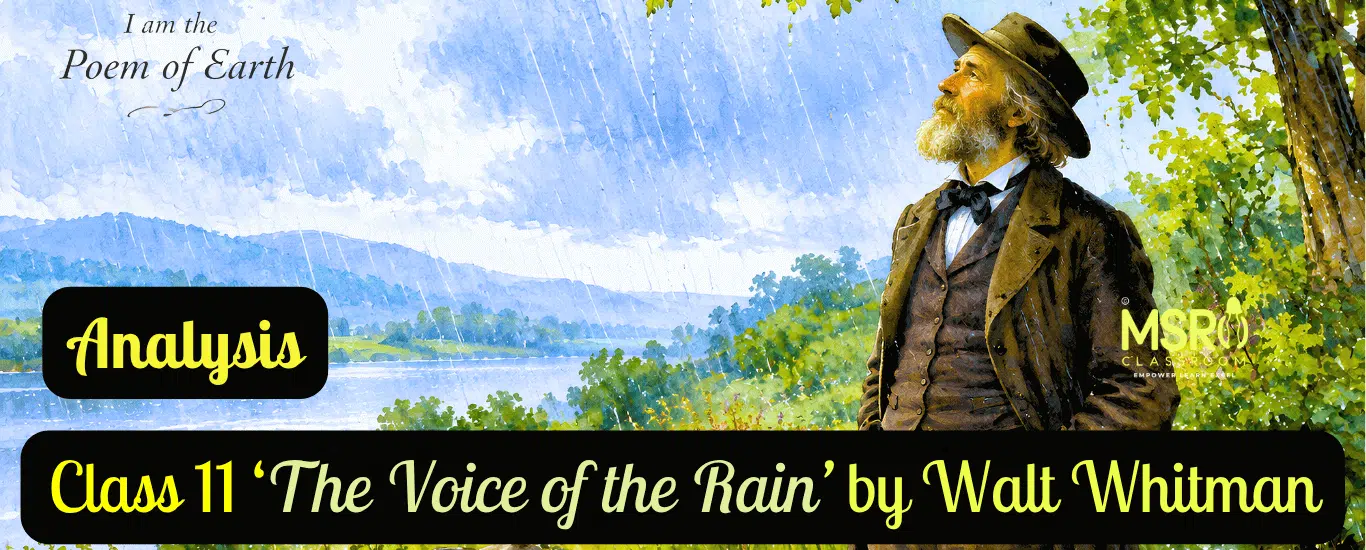
Poem 3, Walt Whitman’s ‘The Voice of the Rain’ Summary, Analysis, Theme, Line-by-Line Explanation, Extra Questions, Literary Devices, Textbook Question Answers with Extract Based Questions.
Poem 3- The Voice of the Rain by Walt Whitman:
Walt Whitman
Walt Whitman (1819-1892) was an American poet, essayist, and journalist, often called the “father of free verse.” His magnum opus, “Leaves of Grass,” revolutionised American poetry by celebrating democracy, individualism, and nature.
‘The Voice of the Rain’ was first published in a periodical named ‘Outing’ in August 1885 and was also reprinted in ‘Leaves of Grass‘, 1897 edition.
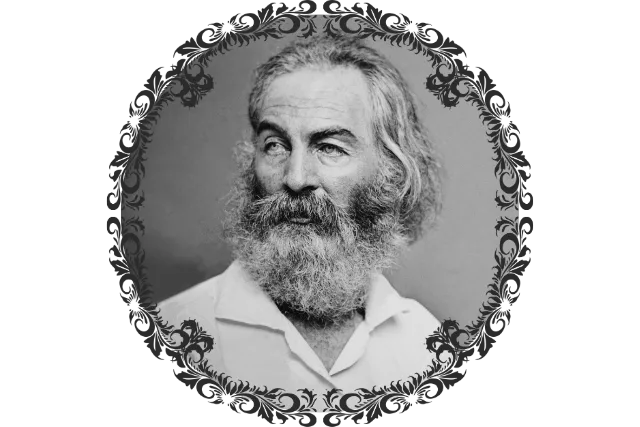
Table of Contents
Supplementary Reader: Class 11 ‘Snapshots‘
Vocabulary:
- Impalpable: Not able to be felt by touch; intangible.
- Form’d: Formed, but in an older, poetic spelling style.
- Lave: To wash or bathe; it is used metaphorically to describe the rain’s action.
- Atomies: Tiny particles or specks, often used metaphorically to describe dust or small elements.
- Latent: Existing but not yet developed or manifest; hidden or concealed.
- Unborn: Not yet brought into existence; here, referring to potential life within seeds.
- Beautify: To enhance or make beautiful.
- Reck’d: An archaic form of “reckoned” or “considered.”

Summary “The Voice of the Rain”:
IIn “The Voice of the Rain,” Walt Whitman personifies rain as the “Poem of Earth,” capturing the essence of the planet. Rain’s journey from land and sea to the heavens symbolizes the cyclical nature of life. Its descent back to Earth promotes growth, cleansing, and revitalization. Whitman’s metaphor of rain as a song emphasizes its harmonious role in this eternal cycle.
The poet explores nature’s interconnectedness through a dialogue with rain, highlighting its life-giving power and cyclical patterns. Rain’s significance goes beyond its physical attributes; it serves as a vital link in the life cycle and is depicted as purposeful nourishment. Whitman’s imagery illustrates rain’s transformative power, connecting it to universal themes of renewal and vitality. Ultimately, rain emerges as a symbol of both constancy and change, reflecting the enduring rhythms found in nature.
Explanation of ‘The Voice of the Rain’ for Auditory Learners:
The Voice of the Rain Explanation:
- In “The Voice of the Rain” by Walt Whitman, rain is personified as a living force with a clear identity and purpose in nature. The poem starts with someone asking about rain and getting a mystical answer, suggesting a deep spiritual connection to nature.
- The rain, portrayed as alive, calls itself the “Poem of Earth,” showing that it embodies nature’s essence and beauty. It says it comes from the land and sea, symbolising the water cycle’s continuous nature.
- As it rises to the sky and changes form, the rain remains the same at its core. When it falls back to earth, it nourishes the land, washing away dryness and dust. It emphasises its role in helping seeds grow and bloom.
- The rain’s constant cycle of going up and coming down is shown as a life-giving force. It always returns life to its origin, making the world cleaner and more beautiful. The rain’s return is compared to a song that wanders and returns, showing a continuous flow of love and renewal.
In “The Voice of the Rain,” Walt Whitman celebrates rain’s essential role in keeping life going and its deep connection to nature. The poem portrays rain as a poetic, timeless force, symbolising nature’s power to renew and affirm life. Whitman’s strong bond with the environment and his depiction of rain’s mystical voice inspire awe and respect for life’s cycles and nature’s endless creations.
Analysis “The Voice of the Rain”:
1. Identity of Rain:
- Rain is personified as a living entity with its own “voice” and “purpose.”
- It identifies itself as the “Poem of Earth,” suggesting it is essential for life and beauty on Earth.
2. Nature of Rain:
- Rain rises “impalpable” from the land and sea, meaning it comes from places that cannot be touched or felt.
- This emphasises the mysterious and spiritual nature of rain.
3. Cycle of Rain:
- After rising, rain ascends to the sky and then returns to Earth.
- It changes but remains fundamentally the same, symbolising the continuous cycle of life and renewal in nature.
4. Role of Rain:
- Rain quenches the Earth’s thirst, reaching dry areas and awakening dormant seeds.
- It sustains physical life and brings forth new growth and beauty.
5. Spiritual Significance:
- Rain’s “song,” representing its life-giving power, returns with love after fulfilling its purpose.
- This illustrates the deep connection between nature and its creations, highlighting the cycle of giving and receiving.
6. Poem’s Message:
- “The Voice of the Rain” celebrates rain as a poetic and vital natural force.
- It symbolises rain’s ability to sustain and rejuvenate life on Earth, inviting us to appreciate the beauty and wonder of nature’s rhythms.
More in the video explanation.
Theme “The Voice of the Rain”:
- The Vitality of Nature: One central theme of this poem is nature’s perpetual vitality and regeneration. The rain, personified as a sentient being, describes its eternal cycle of rising from the Earth and the sea, ascending to the heavens, and returning to the Earth to nourish and renew all living things. The poem celebrates nature’s life-giving and rejuvenating power.
- Connectedness of All Life: Whitman’s poem emphasises the interconnectedness of all life forms on Earth. The description of how rain descends to “lave the droughts” and bring life to latent seeds highlights the idea that all living beings are part of a vast, interconnected ecosystem. It underscores the notion that everything in the natural world is interdependent.
- The Perpetuity of Art and Creation: Through the rain’s assertion that it is “the Poem of Earth,” Whitman suggests that art and creativity are inherent aspects of the natural world. The rain’s eternal cycle mirrors the cyclical nature of artistic and creative expression. Like the rain, art is continually born, fulfilled, and returns to its source, potentially impacting and beautifying the world in the process.
- The Transcendence of Time and Change: The poem explores the idea that while the rain changes as it rises and falls, it remains fundamentally the same. This theme of continuity amid change reflects Whitman’s broader belief in the enduring nature of the human spirit and the timeless aspects of life.
Line-by-Line Explanation “The Voice of the Rain”:
Line 1: “And who art thou?” said I to the soft-falling shower, The speaker addresses the rain, asking who or what it is.
Line 2: “Which, strange to tell, gave me an answer, as here translated:” The speaker finds it unusual that the rain seems to respond, indicating a personification of nature.
Line 3-4: “I am the Poem of Earth, said the voice of the rain,
Eternal I rise impalpable out of the land and the bottomless sea,”
The rain, personified as a sentient being, identifies itself as the “Poem of Earth.” It describes its eternal nature, rising from the land and sea, symbolising its continuous cycle.
Line 5-6: “Upward to heaven, whence, vaguely form’d, altogether changed, and yet the same,” The rain rises towards the sky, where it transforms yet remains constant in its purpose.
Line 7-8: “I descend to lave the droughts, atomies, dust-layers of the globe,
And all that in them without me were seeds only, latent, unborn;”
The rain descends to quench the earth’s thirst, washing away dryness and nurturing latent life.
Line 9-10: “And forever, by day and night, I give back life to my own origin,
And make pure and beautify it;”
Rain sustains the life cycle, rejuvenating the earth and enhancing its purity and beauty.
Line 11-12: “(For song, issuing from its birth-place, after fulfilment, wandering
Reck’d or unreck’d, duly with love returns.)”
Like a song, the rain begins at its birthplace, travels through the cycle, and eventually returns with love and purpose.
‘The Voice of the Rain’ shows Walt Whitman’s belief that nature and humanity are connected. The rain, portrayed as a poetic force, shows how essential it is to life and to keeping nature balanced. Whitman deeply values nature’s cycles and how they can inspire and renew people.
Questions Answers “The Voice of the Rain”:
Textbook Question Answers:
Q1: There are two voices in the poem. Who do they belong to? Which lines indicate this?
A1: In “The Voice of the Rain,” there are two voices: one belonging to the speaker (presumably Walt Whitman) and the other to the rain itself.
The lines indicating these voices are:
- The speaker’s voice: “And who art thou? said I to the soft-falling shower,”
- The rain’s voice: “I am the Poem of Earth, said the voice of the rain,”
Q2: What does the phrase “strange to tell” mean?
A2: “Strange to tell” means something unexpected or surprising. In this context, it suggests the unusual or unpredictable nature of the rain’s response to the speaker’s inquiry.
Q3: There is a parallel drawn between rain and music. Which words indicate this? Explain the similarity between the two.
A3: In “The Voice of the Rain,” the parallel between rain and music is indicated by the following words:
“For song, issuing from its birth-place, after fulfilment, wandering”
“duly with love returns.”
The similarity between rain and music lies in their cyclical nature. Just as a song originates in its birthplace, embarks on a journey, and eventually returns to its origin, rain similarly rises from the land and sea, transforms in the heavens, descends to the earth, and returns to its source. Both rain and music follow a pattern of departure, journey, and return, symbolising a cyclical rhythm.
Q4: How is the cyclic movement of rain brought out in the poem? Compare it with what you have learnt in science.
A4: In science, the cyclic movement of rain is explained through the water cycle. Water evaporates from bodies of water and land surfaces due to heat energy from the sun, forming clouds. These clouds then condense and precipitate as rain, snow, or other forms of precipitation back to the Earth’s surface.
The water then flows into rivers, lakes, and oceans, where the cycle begins again. The process mirrors the poem’s cyclical movement, highlighting nature’s interconnectedness and continuity.
Q5: Why are the last two lines put within brackets?
A5: The last two lines in the poem are put within brackets or parenthesis to indicate that they are a parenthetical/an incidental aside or additional commentary.
They further emphasise the connection between rain and music by comparing rain’s journey to a song’s wandering. Additionally, they provide a reflective commentary on the cyclical nature of rain’s replenishing journey.
Q6: List the pairs of opposites found in the poem.
A6: Pairs of opposites found in the poem include:
- Soft-falling shower vs. droughts
- Rise vs. descent
- Life vs. death
- Heaven vs. earth
- Impalpable vs. tangible
- Changed vs. the same
- Lave vs. dust-layers
- Seeds vs. latent, unborn
- Life vs. origin
- Pure vs. impure
- Beautify vs. dust-layers
- Reck’d vs. unreck’d
II. Notice the following sentence patterns.
1. And who art thou? said I to the soft-falling shower.
2. I am the Poem of Earth, said the voice of the rain.
3. Eternal I rise
4. For song… duly with love returns
Rewrite the above sentences in prose.
Answers:
- The soft-falling shower, I asked, “And who are you?”
- The voice of the rain replied, “I am the Poem of Earth.”
- I rise eternally.
- The song, after fulfilment, returns with love.
Extra Questions “The Voice of the Rain”:
Q1: Who is the speaker in the poem ‘The Voice of the Rain’?
A1: The speaker is the persona, possibly the poet, conversing with the rain.
Q2: What does the rain identify itself as?
A2: The rain identifies itself as “the Poem of Earth,” implying its significant role in the natural world.
Q3: How does the rain describe its origin and nature?
A3: The rain describes itself as eternal, rising impalpable from the land and bottomless sea, ascending to heaven, and then descending to replenish the earth with life-giving water.
Q4: What does the rain claim to do to the globe’s droughts, dust layers, and seeds?
A4: The rain claims to revive (moisten) the droughts, dust layers, and latent, unborn seeds of the globe, bringing life and growth.
Q5: What impact does the rain have on its own origin?
A5: The rain rejuvenates its own origin, giving back life and purity to the sources from which it arises.
Q: How does the rain compare to a song?
A5: The rain compares itself to the song, suggesting that, like music, it issues forth from its birthplace and, after fulfilling its purpose, wanders around and eventually returns with love.
Q6: What is the central theme of the poem ‘The Voice of the Rain’?
A6: The poem explores rain’s life-giving and renewing nature, portraying it as vital in sustaining and beautifying the Earth. It emphasises rain’s cyclical and eternal character as it perpetually replenishes its source.
A7: The poem “The Voice of the Rain” by Walt Whitman explores rain’s mystical, elemental nature by personifying it as a conscious entity. Through the speaker’s conversation with the rain, Whitman explores themes of life, renewal, and interconnectedness in the natural world.
The rain’s response presents its multifaceted role in the Earth’s ecosystem, symbolising a life-giving force and a carrier of poetic inspiration.
Q8: What does the rain’s assertion that it is rising “impalpable out of the land and the bottomless sea” signify?
A8: The line emphasises rain’s origin from the Earth and the vast oceans. Rain is portrayed as an ethereal entity that emerges from the land and sea. The term “impalpable” highlights its intangible, insubstantial nature, while “bottomless sea” symbolises the vastness and depth of the water sources from which the rain originates.
Q9: What does the rain mean when it claims to rise “Upward to heaven, whence, vaguely form’d, altogether changed, and yet the same”?
A9: The phrase suggests the rain’s transformative journey from its origin to the sky and back to Earth. The rain rises to the heavens, changing and transforming yet retaining its fundamental essence.
It mirrors the evaporation-condensation-precipitation cycle of the water cycle, highlighting its cyclical, unchanging nature.
Q10: What is the significance of the rain’s cyclic nature described in the poem?
A11: The poem emphasises the rain’s cyclical nature, which rises, transforms, descends, and repeats the process. The cyclical nature symbolises the eternal renewal and regeneration of life on Earth. The rain is a constant and reliable force that brings life and beauty to the world, day and night.
Q12: How does the poem connect the rain to poetry and love?
A12: The poem suggests a connection between rain, poetry, and love by stating, “For song, issuing from its birth-place, after fulfilment, wandering, Reck’d or unreck’d, duly with love returns.” The rain has a cyclical, enduring nature, like poetry and love. Just as poetry and love return after being expressed, the rain continues its cycle of nourishing the Earth, demonstrating its poetic and loving qualities.
Extract Based Questions “The Voice of the Rain”:
Extract 1:
“I am the Poem of Earth, said the voice of the rain,
Eternal I rise impalpable out of the land and the bottomless sea,
Upward to heaven, whence, vaguely form’d, altogether changed,
and yet the same,”
Q1: Who does the voice of the rain claim to be?
A1: The voice of the rain claims to be the “Poem of Earth.”
Q2: From where does the rain say it rises?
A2: The rain says it rises “impalpable out of the land and the bottomless sea.”
Q3: To where does the rain ascend after rising from the land and sea?
A3: The rain ascends “upward to heaven.”
Q4: How does the rain describe its transformation as it rises?
A4: The rain describes its transformation as “vaguely form’d, altogether changed, and yet the same.”
Q5: What literary device is used when the rain refers to itself as the “Poem of Earth”?
A5: The literary device used is personification, as the rain is given human attributes and a voice.
Q6: What does “impalpable” mean in the context of the poem?
A6: In the poem’s context, “impalpable” means something that cannot be touched or felt, emphasising the rain’s intangible /untouchable/bodiless nature as it rises.
Q7: How does the extract illustrate the cyclical nature of the rain?
A7: The extract illustrates the cyclical nature of the rain by describing its journey from the land and sea, rising to the heavens, transforming, and yet remaining essentially the same, implying a continuous and recurring process.
Q8: What theme is highlighted by the rain’s assertion that it rises “altogether changed, and yet the same”?
A8: The theme highlighted is transformation and continuity, suggesting that while rain changes form, its essence/nature/spirit remains constant, reflecting the natural cycle and renewal.
Q9: What does the rain identify as in the poem, and how does it describe its eternal nature?
A9: The rain identifies itself as the “Poem of Earth.” It describes itself as eternal, rising invisibly from the land and the boundless sea. It transforms as it rises towards the heavens, remaining altered and constant.
Q10: How does the rain’s journey from the land and sea to the heavens symbolise its nature and purpose?
A10: The rain’s journey from land and sea to the heavens symbolises its transformative, life-giving nature. It rises to the sky, changing while retaining its core identity. This journey reflects how rain nourishes and sustains the earth, replenishing life and bringing about growth and renewal.
Q11: In Walt Whitman’s poem “The Voice of the Rain,” the rain says, “I am the Poem of Earth.” How does this show that natural elements are eternal and constantly changing, and why is this important in the poem?
A11: In Walt Whitman’s poem “The Voice of the Rain,” the rain declares, “I am the Poem of Earth.” This suggests that rain symbolises nature’s eternal, ever-changing power.
Rain originates from the land and sea, illustrating its deep connection to the Earth. As it rises to the sky and changes form, it represents the cycle of life and renewal.
This concept is important because it emphasizes how nature inspires and revitalizes itself. Whitman employs the imagery of rain to highlight the interconnectedness and enduring vitality of the natural world. The cycle of the rain—rising, transforming, and returning, mirrors the continuous cycle of life.
Extract 2:
“I descend to lave the drouths, atomies, dust-layers of the globe,
And all that in them without me were seeds only, latent, unborn;
And forever, by day and night, I give back life to my own
origin, and make pure and beautify it;
(For song, issuing from its birth-place, after fulfilment, wandering,
Reck’d or unreck’d, duly with love returns.)”
Q1: What does the rain say it does when it descends to the Earth?
A1: The rain says it “descend[s] to lave the drouths, atomies, dust-layers of the globe.”
Q2: What happens to the seeds without the rain?
A2: Without the rain, the seeds remain “latent, unborn.”
Q3: How does the rain describe its effect on the Earth?
A3: The rain describes its effect as giving back life to its origin and making it pure and beautiful.
Q4: What does the rain symbolise in its continuous cycle of giving life?
A4: The rain symbolises the cycle of life, renewal, and purification in nature.
Q5: How does the rain compare to a song in the poem?
A5: The rain compares itself to a song that, after being fulfilled, wanders and returns with love to its birthplace.
Q6: What literary device is used when the rain says it “descends to leave the drouths”?
A6: The literary device is imagery, which creates a vivid picture of rain washing away drought.
Q7: What is the significance of the rain’s action of giving back life “by day and night”?
A8: The significance is that rain is a constant, essential force that maintains the Earth’s vitality and purity and operates continuously.
Q9: How does the extract reflect the interconnectedness of natural elements?
A9: The extract reflects the interconnectedness by showing how the rain nourishes the Earth, allowing seeds to grow and sustain life, thus completing the natural cycle.
Q10: What are the rain’s role in the earth and its elements as described in this extract?
A10: The rain describes its role in descending to cleanse and nourish the world’s dry, barren parts. It brings life to dormant seeds and latent life forms, transforming them into vibrant living entities.
Q11: How does the rain’s action of “giving back life to its own origin” resonate with the theme of the poem?
A11: The rain rejuvenates its origin by nourishing the earth and all its life forms, aligning with the theme of interconnectedness and the cyclical nature of life. This cycle of giving and receiving, birth and renewal, reflects the perpetual harmony of nature and its life-sustaining processes.
Q12: In the extract from “The Voice of the Rain” by Walt Whitman, the rain talks about how it helps the Earth. How does this show the rain’s power to change and give life, and what bigger ideas about nature and renewal do it show?
A12: In this excerpt from “The Voice of the Rain” by Walt Whitman, the rain speaks about its role in helping the Earth. It illustrates how rain transforms the environment by washing away drought and dust, allowing seeds to grow.
Rain’s actions are part of a cycle: it falls to nourish the Earth, then returns to the sky. The cycle highlights the deep connection between nature and life. The rain is depicted as a nurturer and purifier, contributing to Earth’s beauty.
The excerpt emphasizes themes of nature’s eternal cycles and its ability to sustain life. It reflects how everything in nature is interconnected and how the processes of giving and receiving are integral to these cycles. Whitman celebrates the beauty and harmony of the natural world.
Extract 3:
“(For song, issuing from its birth-place, after fulfilment, wandering,
Reck’d or unreck’d. duly with love returns.)”
Q1: What does the “song” do after it is issued from its birthplace?
A1: The song, after fulfilment, wanders.
Q2: How does the song return after wandering?
A2: The song returns with love.
Q3: What does “reck’d or unreck’d” mean in the context of the poem?
A3: “Reck’d or unreck’d” means whether it is noticed or unnoticed, cared for or not.
Q4: What literary device is used in the phrase “duly with love returns”?
A4: The literary device used is personification, as the song gives the human the ability to return with love.
Q5: How does the song’s metaphor relate to the poem’s theme?
A5: The song’s metaphor relates to the poem’s theme by illustrating the cycle of life, fulfilment, and return, like the rain’s cycle.
Q6: Why is the return of the song significant in the poem?
A6: The return of the song is significant because it symbolises completion and the enduring nature of creation and love.
Q7: How does this extract reflect the poem’s message about nature and renewal?
A7: This extract reflects the poem’s message about nature and renewal by showing that, like a song, natural elements fulfil their purpose and then return to start the cycle anew.
Q8: What is implied by the phrase “duly with love returns” about the song?
A8: The phrase implies that the song returns lovingly and adequately, signifying care and appreciation for the cycle of creation.
Q9: What does the concept of the song “issuing from its birthplace” suggest about the role of rain?
A9: The idea of a song issuing from its birthplace implies that the rain’s purpose is to resonate harmoniously with the world. It emerges from its origin to fulfil its role, wandering across the earth to bring its life-giving essence wherever it goes.
Q10: How does the rain’s return “duly with love” relate to its interaction with the earth?
A10: The rain’s return “duly with love” signifies its nurturing and benevolent nature. It returns to the earth consistently and with care, fulfilling its role in sustaining life, cleansing, and enriching the environment.
Q11: How do these lines show the rain’s song as a cycle? How do they capture the deep connection between the rain’s song and the cycle of life and nature?
A11: In Walt Whitman’s poem “The Voice of the Rain,” the lines “(For song, issuing from its birth-place, after fulfillment, wandering, reck’d or unreck’d, duly with love returns)” illustrate the rain’s song as a continuous cycle. These lines convey that the rain’s song begins when it forms in the atmosphere. After it nourishes the earth, the song continues, whether it is noticed or not (“reck’d or unreck’d”).
The phrase “duly with love returns” signifies that the rain’s song always returns to its source, full of love. This cycle is essential for sustaining life and nature. These lines highlight the endless and renewing nature of the rain’s song, emphasizing the deep connection between nature and the cycle of life.